

USDT is one of the Cryptocurrencies more established, not only among crypto investors, but also among people who want to save in dollars, or are looking for a way to protect their money against inflation.
It is designed to maintain a stable value in relation to the US dollar and the idea gave birth to the famous “stablecoins”. One of its main advantages is that it works to protect against the volatility of other cryptocurrencies, and to facilitate fast and global transactions in dollars.
If you're wondering what USDT is and how it works, we'll explain it to you in this article!
What is USDT or Tether (TRC-20) and what is it for?
USDT, known as Tether, is a cryptocurrency that was created in 2014 by Tether Limited Inc. To understand what USDT means, its main characteristic is that it is designed to maintain a stable value, pegged to the US dollar.
This means that, in theory, each unit of USDT should have a value equivalent to one dollar, which establishes that there is a 1:1 parity between the two currencies.
However, in practice, this parity is not always guaranteed, as it can be affected by market factors or confidence in the asset, as will be discussed later.
USDT is used as a protection tool for users and investors in the cryptocurrency sector, as it helps them mitigate the high volatility that characterizes this market.
This refers to sudden fluctuations in the value of cryptocurrencies, which tend to occur constantly due to regulatory changes, controversies, and major economic or political events.
However, the usefulness of USDT is not only limited to this, since it is also often used in other scenarios such as:
- Safe haven against inflation: In countries where inflation has reached alarming levels and the local currency has rapidly lost its purchasing power, USDT offers a way to Maintain the value of money.
- Remittances and international transfers: Money transfers through traditional methods, such as Western Union, tend to be more expensive due to their fees that vary depending on the country and the amount to be sent. They can also take several hours or even days, unlike USDT, which are usually almost instantaneous and with very low fees.
- Payments and purchases: The growing adoption of cryptocurrencies as a means of payment has motivated businesses to explore these options. Thanks to its price stability and high liquidity, USDT allows businesses to integrate digital payments without being exposed to the volatility typical of the crypto market, while expanding their reach to new, unbanked consumers.
How does USDT (TRC-20) work?
USDT works by issuing tokens that are backed by asset reserves (cash, precious metals, and others) equivalent to the total amount of USDT in circulation. That is, for every dollar that is deposited, a corresponding USDT token is created.
This ensures that there are always enough reserves to support each token that is issued. In theory, each USDT token is designed to be redeemed for one U.S. dollar.
The company responsible for issuing and managing USDT is Tether Limited Inc. When a customer, which can be an exchange, a financial institution or any other entity deposits dollars in bank accounts controlled by Tether, the company creates smart contracts with the corresponding protocols (TRC-20, ERC-20, BEP-20, etc.) to issue an equivalent amount in USDT.
If the customer wants to convert their USDT back to dollars. Tether destroys the corresponding amount of USDT on the blockchain and transfers the dollars back to the customer.
What are the technical characteristics of USDT (TRC-20)?
- Unlimited supply: Tether can issue new units of USDT or withdraw from circulation based on demand. This makes it possible to maintain the liquidity and stability of the token under different market conditions.
- 1:1 parity: Each USDT is backed by one U.S. dollar. Tether releases regular reports on its reserves to ensure confidence in USDT parity.
- High market share: USDT maintains approximately 4.0% of dominance in the cryptocurrency market, compared to 1.1% of USDC. Tether is one of the 5 most used cryptocurrencies globally.
- Compatible with multiple blockchains: According to their official page, the USDT token is backed by more than 13 blockchains, such as Ethereum (ERC-20), Omni (Bitcoin), BEP-20 (Binance Smart Chain), and TRC-20 (Tron), making it easy to use on multiple platforms.
- Highly secure digital asset: Blockchain technology uses advanced cryptography to protect data and transactions. Tether is available on blockchain networks that have an excellent reputation, recognized for their innovations and their robustness to hacking attempts.
How safe is USDT (TRC-20)?
It is a secure cryptocurrency since it is Issue on blockchains, such as Ethereum (ERC-20), Tron (TRC-20), and others, which stand out for their robust security protocols and are widely used and audited.
However, the security of USDT is also influenced by its characteristic of being a currency with 1:1 parity against the US dollar; that is, its stability is conditioned on the ability to maintain that parity.
This financial security depends on Tether Limited Inc having the necessary reserves to support 1:1 parity. For this purpose, Tether uses an asset backup mechanism, which means that the company is committed to having a reserve of assets (cash, gold, etc.) that are equivalent to the amount of USDT in circulation.
In other words, if there are 100 million USDT, Tether must have 100 million dollars in its reserves.
According to your Latest report on reservations, 83.89% is in cash and short-term deposits, mainly in treasury bills, while the remaining, 16.11%, is in bitcoins, precious metals, and other investments.
Advantages and disadvantages of USDT (TRC-20)
Advantages
- Low volatility: It has a 1:1 parity with the US dollar.
- Low fees and fast transactions: Especially on networks like Tron (TRC-20) and Solana.
- Wide adoption: Available on numerous exchanges and platforms.
- Multi-blockchain: It is available on several blockchains.
- Stability in volatile markets: It is a safe option during periods of high volatility.
Disadvantages:
- Questionable transparency: There is historic mistrust about the veracity of their reservations.
- Asset freeze risk: Tether Limited Inc has the power to sanction users for comply with the authorities.
- Dependence on the US dollar: The stability and monetary policy of the dollar influence Tether.
- Impact on market reputation: Problems related to Tether can harm the image of the market and the value of cryptocurrencies.
How to buy USDT in Bolivia with El Dorado P2P?
If you want to learn how to have a USDT account in Bolivia, El Dorado P2P offers you a simple and secure registration to buy your first stablecoin. Just follow these steps:
If you don't have a user account:
- Visit our official website at eldorado.io or download the El Dorado P2P app from Google Play (for Android) or from the App Store (for iOS).
- Then, create your account by clicking “Register” or pressing the “Create Account” button if you are doing so from a mobile device.
- Next, fill in all the information required to create your account.
- After that, check your email and locate the verification code you need and enter it in the corresponding field.
- With the application, proceed to carry out KYC verification by clicking on the settings symbol. Then, in the “Profile” section, look for the “verification (KYC)” option and follow all the instructions.
If you already have your user account and it has been verified:
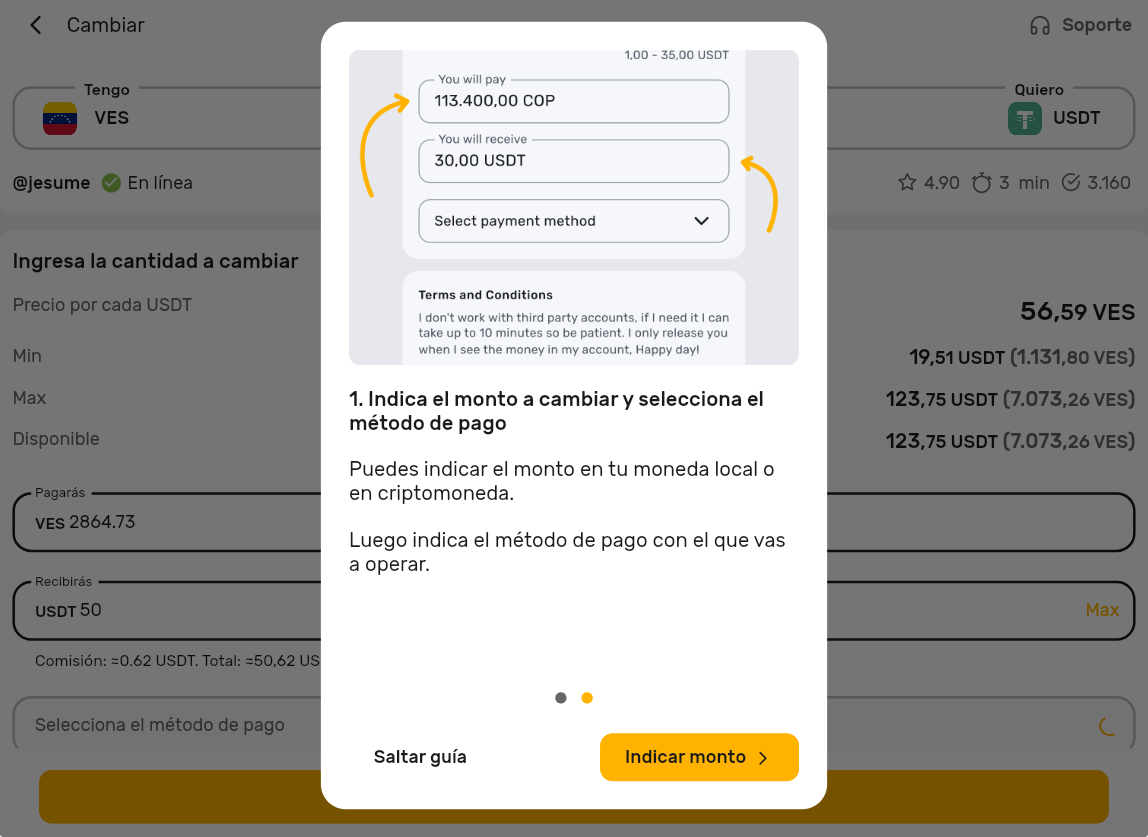
- Go to the “Change” tab, here you will find a very easy tool for buying and selling:
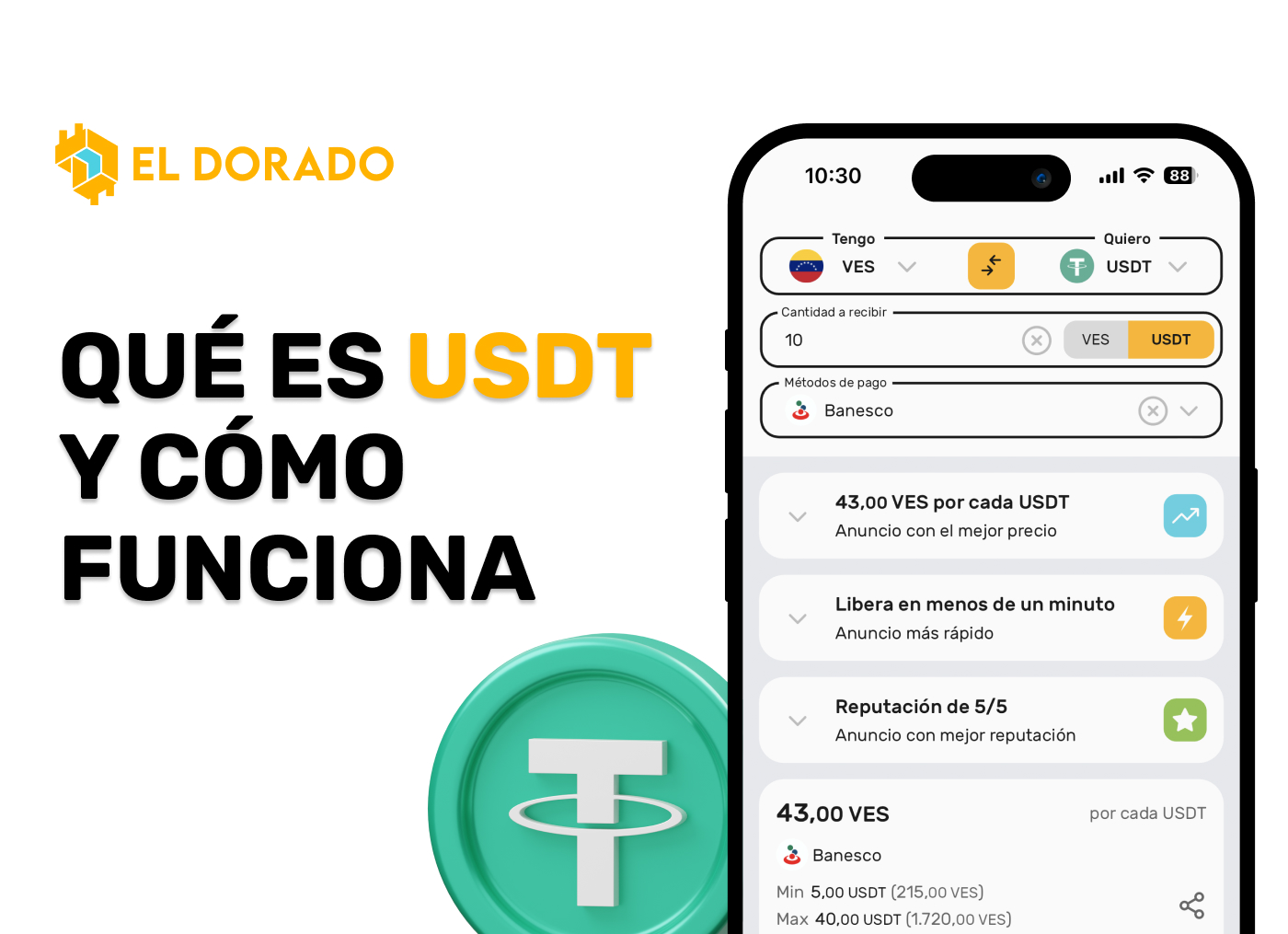
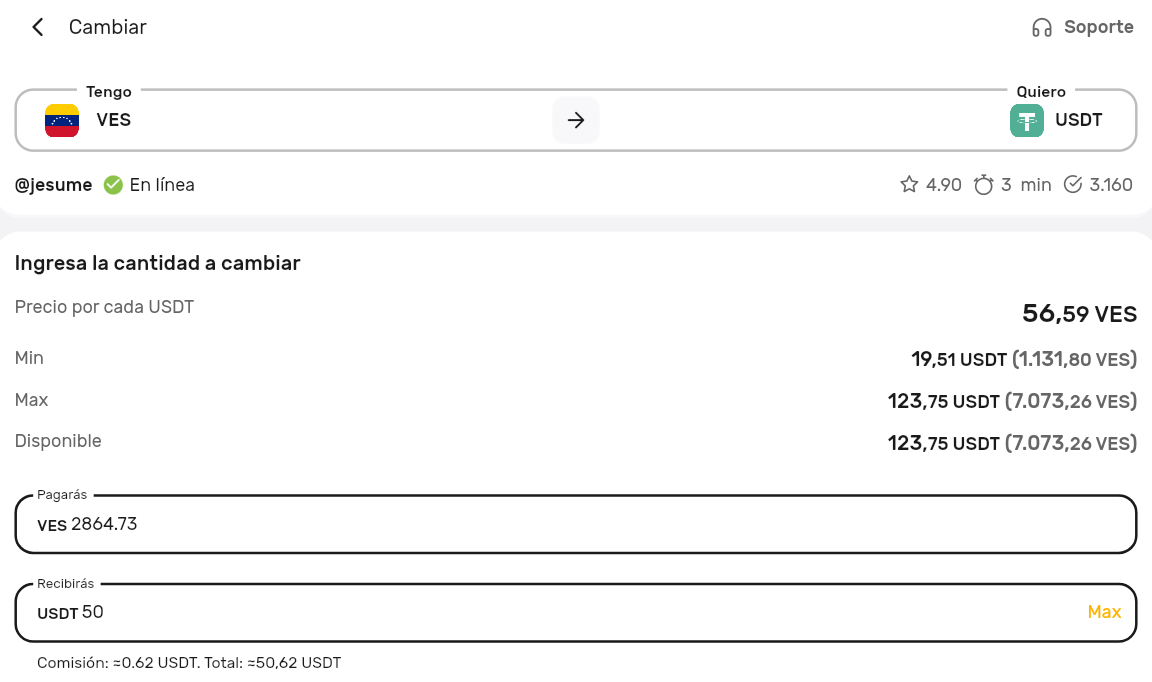
At the top you'll find two drop-down menus: “I have” and “I want”. As you may have guessed, in “I have” you will choose the currency you have to make the exchange, which will be BOB, while in “I want” you will select the currency you want to receive, which will be USDT. If you can't find BOB in “I have”, click on the exchange symbol.
Now, choose a payment method and enter the amount you want using the on-screen keyboard. Then click “Next” and our system matches you with the best deals available.
- Choose one of the available orders; doing so will show you the amount to send. If you agree, click “Change” and you'll get the user's bank address and a private chat to communicate with them (For more details, check out our guide).
- Finally, make the payment and then click on “Payment made”, this will let the user know that you have made the deposit and will release the USDT to your account. And that's all!
How can I transfer the USDT from my El Dorado wallet to my bank account?
Transfer USDT from your account El Dorado P2P to your bank account, you have to convert USDT to BOB through the following steps:
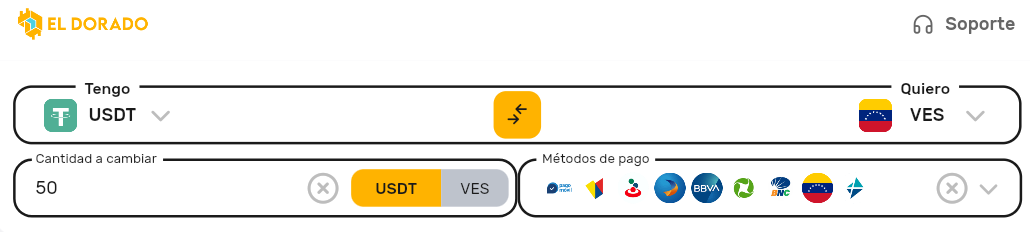
- Go to the “Change” tab. In the drop-down menus, under “I have” place USDT and under “I want” select BOB.
- Enter the amount you want to exchange using the on-screen keyboard and press “Next”.
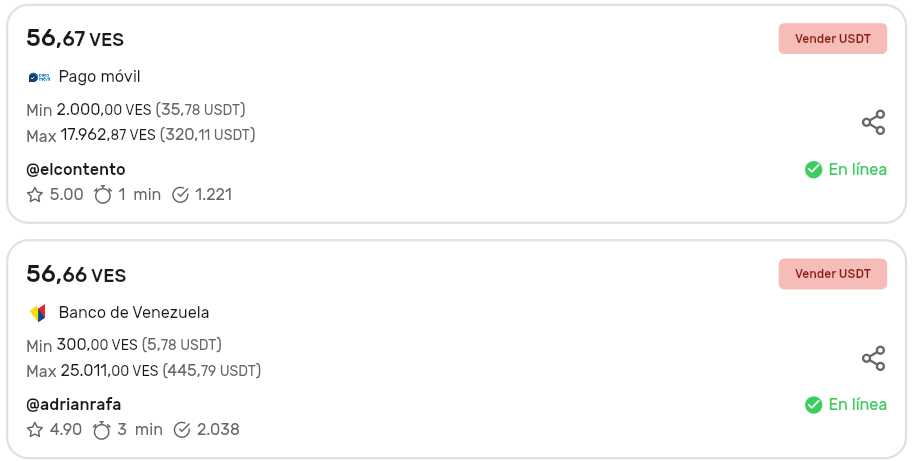
- Choose one of the available orders; doing so will show you the amount you will receive. If you agree, select a payment method, that is, the bank address where the user must deposit the money and then click on “Change”.
- Communicate with the user through the private chat and wait while they perform the operation.
- Once the user confirms the deposit, verify the amount in your bank account. If everything is correct, press “Confirm payment”. And ready!
For security, never share your bank password or that of your El Dorado P2P account through private chat.
What's the difference between USDT (TRC-20) and USDC?
Both Tether (USDT) and USD Coin (USDC) are considered the main stablecoins. According to data from the CoinGecko market tracker, together they account for 91% of market dominance, with Tether being the most used, with 71%.
Although USDT and USDC are similar currencies, they have different characteristics and risks that are important to know. Some of the most notable differences are:
- Issuer: The USDT token is issued by Tether Limited Inc, based in Hong Kong, and its parent company is Tether Holdings Limited, located in the British Virgin Islands. On the other hand, the USDC is issued by Circle, headquartered in Boston, United States (USA).
- Legal compliance: The USDC has greater transparency since it is subject to strict US regulations, such as oversight by entities such as the SEC and FinCEN. Although USDT has historically faced controversy over its reserves in recent years, the company has worked to improve its transparency.
- Availability: USDT was originally launched on Bitcoin's Omni Layer protocol, but later expanded to various blockchains and layer 2 solutions, such as Ethereum, Tron, Algorand, EOS and many more. As for USDC, it is based on the Ethereum ERC-20 protocol, but due to its growing popularity, it is now available in Solana, Near, Polygon and others, although in slightly smaller quantities than USDT.
- Use case: USDT is widely used for business purposes due to its high liquidity, availability in crypto exchanges, digital wallets, blockchains and services, is also ideal for DeFi for activities such as yield farming, staking, to name a few. On the other hand, USDC is more preferable in scenarios where regulatory compliance and transparency are prioritized, such as institutional or business environments.
Buy USDT quickly and easily with El Dorado. Manage your funds and transfer instantly from our app.