

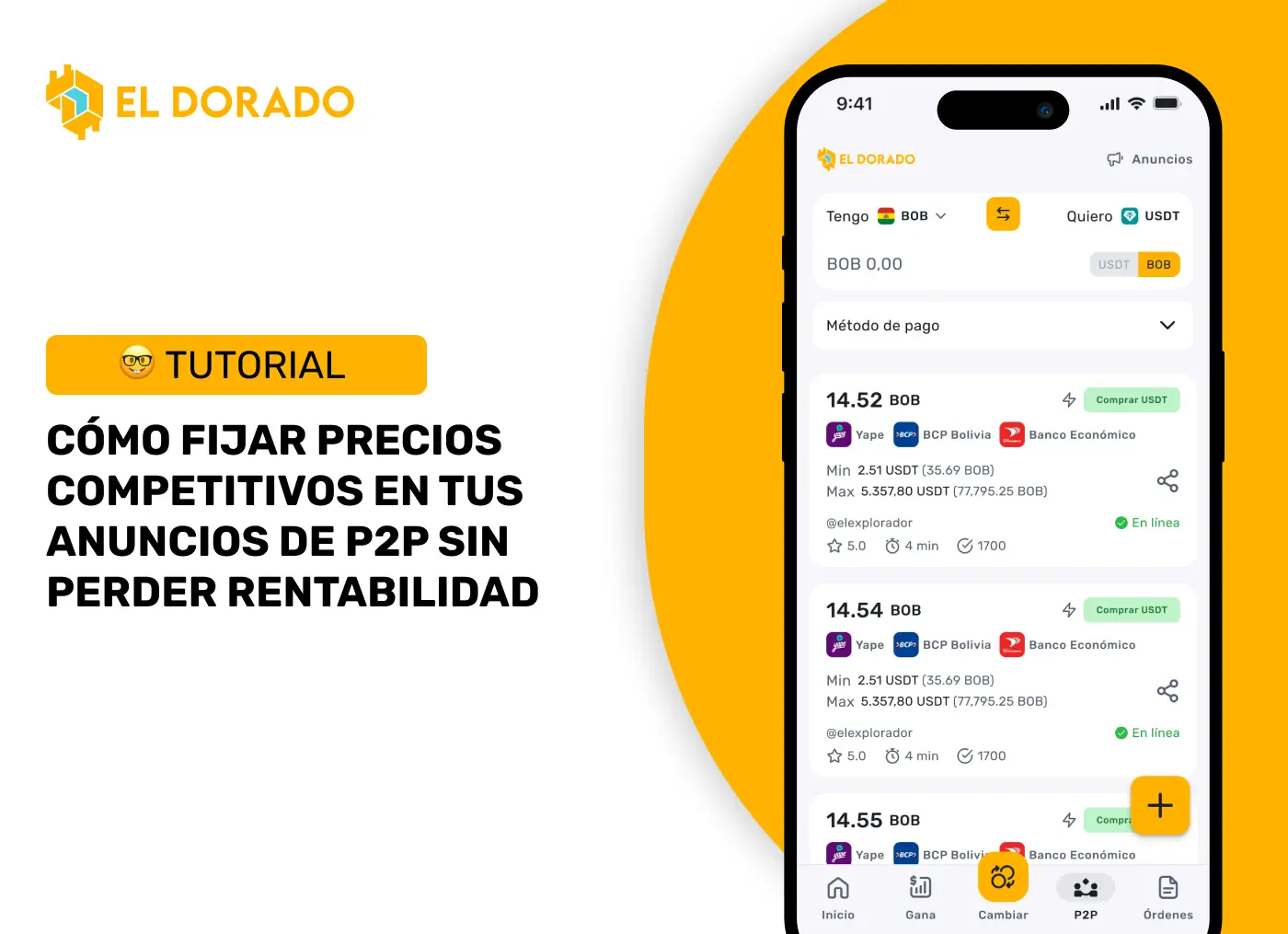
In P2P USDT, price is everything.
If you publish an ad that is too expensive, your operations will be frozen because users will prefer other offers. If you lower the price too low, you can sell quickly, but at the end of the day your profits will be reduced or, even worse, you'll end up trading at a loss.
Then the big question arises: How to set competitive prices for your P2P ads without sacrificing your profitability?
In this article, we'll explore strategies, common mistakes, and practical advice for merchants in Argentina and Latin America who want to maximize their liquidity, attract more customers and maintain healthy margins in the dynamic stablecoin market.
Why is price so important in P2P commerce?
The price in your ads is like the luminous sign of your store: it determines how many customers will come to “buy” from you.
- Visibility in the platform ranking
In most P2P marketplaces, the highest-priced ads (within a competitive range) appear at the top. This means more exposure and, therefore, more chances of closing deals. - Perception of trust
Users are often wary of “off-market” prices, whether they are too low or excessively high. Maintaining a reasonable range builds credibility. - Capital turnover
An adjusted price ensures that your liquidity doesn't stagnate. In volatile markets such as Argentina, selling fast can be more profitable than waiting at an ideal price.
In short, price is your best marketing tool within the P2P ecosystem.
Factors that influence the P2P price of USDT
To set a competitive price, you must first understand what variables affect it:
- Reference price
One of the most important steps in pricing your USDT P2P trading ads is to be clear about the reference price in your local market. This value is usually marked by the official exchange rate, but in many countries there are notable differences with the real price on the street or in the parallel market.
Some examples of this are:
- In the specific case of Argentina, the Blue dollar, the MEP dollar or even the crypto dollar serve as reference points.
- In Peru, although the The Peruvian Sun is relatively stable, there is a very active parallel market. Here, the reference price is not always that of the central bank, but rather that managed by digital and face-to-face exchange offices. For P2P traders, following these rates is key to maintaining competitive prices.
- In Bolivia, due to the strong exchange rate regulation, many times the official exchange rate does not reflect the reality of the market. P2P USDT traders should carefully observe the price on the black or parallel market, since it usually marks the true supply and demand of dollars.
- In other countries, the reference may be the parallel market rate or the official price plus a spread, as in the case of Colombia, where the price is mainly guided by the TRM and a spread is added to it.
👉 In all cases, the important thing is to identify what price buyers and sellers in your region actually use, not just the official one. This way you can adjust your ads to reality and avoid both loss of profitability and being left out of competition.
- Supply and Demand
Prices fluctuate depending on available liquidity. For example:
- At the end of the month, when people get paid, there is usually more demand for USDT.
- On bank holiday days, supply is low and prices tend to rise.
- At the end of the month, when people get paid, there is usually more demand for USDT.
- Payment methods
Not all methods have the same cost or risk.
- Traditional bank transfers (CBU/CVU in the case of Argentina) are usually cheaper.
- Fintech wallets in Argentina (Mercado Pago, Ualá, Lemon) justify higher margins due to their immediate nature.
- In Colombia, for example, it's quite the opposite of Argentina, since traditional bank transfers have taxes such as 4x1000 that make the average price of P2P more expensive. Therefore, fintech wallets in Colombia justify lower margins and better prices due to low or no fees.
- Commissions and hidden costs
- Some banks charge fees for transfers.
- If you use platforms that discount commissions for each trade, you must include it in your margin.
- Some banks charge fees for transfers.
Strategies for setting competitive prices
Now that we know the factors, let's look at concrete strategies:
1. Analyze the competition without falling into price wars
Before posting an announcement, review the order book:
- What rank are the top 5 sellers in?
- What payment methods do you offer?
- What minimum and maximum amounts do you handle?
👉 It's not about being the cheapest always, but about be competitive within your niche.
2. Define a flexible margin
One of the most common mistakes made by new traders is setting margins that are too high with a view to making a quick profit. The reality is that P2P works with adjusted margins, where trust and trading volume outweigh the immediate profit per transaction.
In current practice, competitive margins are usually in a range of 0.25% to 0.75% depending on the country, payment method and level of competition. This range may seem low, but it's the most efficient way to stay at the top of the ads and attract a steady flow of customers.
In addition, it should be considered that in some markets they have been implemented new taxes and additional charges that affect final profitability. Therefore, your strategy must be flexible and dynamic, adjusting prices according to the movement of the competition and always taking care that the margin covers both costs and commissions.
👉 The key is not to make a big profit per trade, but Rotate capital quickly and build trust to attract repeat customers. The important thing is to be clear about your minimum profitable margin and never operate below it.
3. Dynamically update your ads
The crypto market moves minute by minute. A price published in the morning may become obsolete in the afternoon.
Tip: Update your ads at least 3 times a day (morning, afternoon and night).
4. Choose smart schedules
Demand isn't the same all day long.
- Increased activity: among 11:00 a.m. and 2:00 p.m., and of 7:00 p.m. to 10:00 p.m.
- Less activity: early nights or long weekends (although at those times, if you are one of the few available, you can charge a little more).
5. Segment your market
You don't need to compete with everyone. Some traders specialize in:
- High amounts with bank transfer (premium customers).
- Low amounts with fast wallets (retail customers).
How to Stay Profitable Without Losing Customers
The key is to balance volume and margin.
Calculate your minimum profitable price
Example:
- Shopping 1,000 USDT unto $1.05 USD each one → $1,050 USD total.
- Transfer and fee charges: $30 USD.
- Your total cost = $1,080 USD → $1.08 USD per USDT.
👉 In this scenario, you minimum sales price It must be $1.09 USD per USDT so as not to lose money. If you publish your ad for $1.07 or less, even if you sell faster, you would be trading at a loss. The key is to always calculate this breakeven point before setting your prices.
Differentiate yourself beyond the price
The price attracts, but what builds customer loyalty is the experience.
- Speed: release USDT in less than 2 minutes.
- Customer Support: respond with cordiality and clarity.
- Reputation: accumulate positive reviews that validate your seriousness.
Real example:
- Trader A offers the lowest price, but it takes 20 minutes to release funds.
- Trader B charges 1% more, but releases in 1 minute.
👉 The buyer will prefer to pay a little more if they know that they will not have problems.
Common mistakes when setting P2P prices
- Getting into price wars
Many rookies lower their margins so much that they end up working for free or losing. - Don't update prices in volatile markets
If the dollar rises 5% in a few hours and your ad stays the same, you'll lose competitiveness or sell at a loss. - Always copy the competitor
Not everyone has the same costs. What works for another trader may not be profitable for you. - Underestimate bank fees
A fee of $500 ARS per transfer seems like little, but at the end of the month it can eat away at your earnings.
Practical tools and tips
- Margin calculators: use Excel or Google Sheets to simulate prices.
- Price Alerts: exchanges such as Binance or CoinMarketCap allow you to configure notifications.
- Automation: some advanced traders use autoprice bots (if the platform allows it).
- Cash control: record all your inputs and outputs, no matter how small.
To finish
In P2P trading of USDT, it's not about being the cheapest, but about being the smartest when setting prices.
The secret lies in knowing your costs, analyzing the competition, dynamically updating your ads and offering an impeccable service that justifies your margin.
👉 Ask yourself: do you want to sell a lot while earning little, or do you want to sell just enough while maintaining healthy margins? The answer will depend on your strategy, but in both cases discipline will be the key.
At El Dorado you can put these ideas into practice, adjust margins easily and find the perfect balance between competitiveness and profitability. 🚀